
The holiday break: lost time or a strategic opportunity?
Can a holiday be the key to better strategic decisions? Most leaders treat the summer break as a chance to rest and “switch off” from company matters. For company boards, however, a holiday need not mean intellectual idleness. On the contrary, it can be a source of valuable inspiration and a moment for deeper reflection on the organisation’s direction. A respite from everyday pressure can bring a fresh view of the business, revealing opportunities and risks that are missed in the daily routine.
Paradoxically, many people in management positions struggle to make full use of their holidays. Corporate culture still holds the belief that a manager should be always available, even on the beach. According to an OfficeTeam survey, as many as 76% of senior executives admit to dealing with work matters at least a few times a week during their holiday (33% of them every day). By comparison, most lower-level employees can switch off from work completely on holiday: 54% say they never work while on leave.
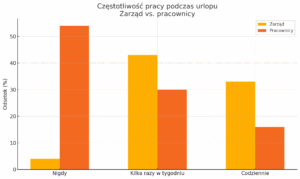
Figure 1: how often managers (the board) and employees work during their holidays (in %). The chart shows a clear difference: management much less often allows itself to switch off completely. Almost one in three managers works every day on holiday, and only a few (4%) manage to never deal with company matters during their holidays. By comparison, more than half of employees say they disconnect fully from work while on leave.
The value of strategic rest
If continuous work without respite is harmful, how should the board use holidays wisely? It turns out that a break from daily duties can bring measurable benefits to the organisation, from increased creativity and a better strategic perspective to more effective implementation of decisions.
First, greater creativity. Breaking away from established patterns and routine tasks encourages new ideas. Our brain makes creative connections when it has the chance to move away from its usual surroundings and stimuli. No wonder the best ideas rarely come in a stuffy conference room after ten hours of meetings. Research confirms this intuition: participants in one experiment who were sent on a four-day wilderness trip without electronics recorded a 50% improvement in creativity test scores on their return. A new environment, contact with nature and the absence of constant emails stimulated their minds to think more innovatively. In business there are well-known examples of CEOs who came up with breakthrough ideas while travelling on holiday. Reed Hastings, the head of Netflix, openly encourages his managers to take long holidays, because he has experienced for himself that returns from holiday bring big ideas for the company. As Hastings has put it, the best thoughts often come when you are hiking in the mountains far from the office and gain a new perspective. Similarly, Bill Gates has for years practised his famous “Think Week”: week-long retreats during which he reads stacks of books and considers future strategies. Gates himself admits that this is when he has his best ideas and can think about long-term direction. These examples show that switching off from day-to-day matters encourages innovative strategic thinking.
Second, a broader perspective. When we put out dozens of fires in the company every day, it is easy to lose the distinction between what is urgent and what is important. A holiday break helps create distance. Stepping away from the company calendar lets you ask: are we really working on the right problems? Often, after returning from holiday, a manager looks at the task list more critically and finds that certain projects could have been questioned or simplified. Researchers call this the goal reactivation effect: briefly interrupting work on a problem means that on returning the mind assesses it more holistically and strategically. In other words, distance from the everyday brings the big picture into focus. From the perspective of Strategy Partners, which supports boards in planning, we often see this effect in our clients: after a well-used holiday break, leaders return with a clearer vision and a readiness to focus on the really key initiatives instead of giving in to “busywork”.
Third, renewed energy and motivation in the team. A rested leader is a better leader: more resilient to stress, optimistic and focused on results rather than just getting through another day. The evidence? Take Ernst & Young’s internal analyses: every additional 40 hours of holiday was associated with lower staff turnover, on average an eight-week increase in retention. Another study covering 125,000 people found that the highest-rated employees take an average of 19 days off a year, while those with lower ratings take only 14. What is more, according to these analyses, for every additional 10 hours of holiday, an employee’s annual rating was 8% higher. Of course correlation is not causation, but these results suggest that balancing intensive work with rest supports effectiveness. Rest also increases engagement: for example, teachers returning after a two-week holiday were less burnt out and more positive about their work. In short, recovery is an investment in the performance of the whole organisation.
How to turn holidays into strategic benefits
Now that we know a holiday can do so much good, the question arises: how do you manage your rest in practice so as to draw lessons for the company from it? Here are some recommendations for managers on how to make the holiday break a creative and strategically productive time:
- Plan a real break. Organise your duties so that you can genuinely disconnect from company matters during your holiday. Before you leave, delegate key tasks to deputies and inform the team of your absence. Agree in advance in which situations they may disturb you and when they should manage on their own. Switch on an email autoresponder with a clear message that you are on holiday. If possible, do not take your work laptop or phone; and if you must, decide to check your inbox, for example, once every two or three days at a set time instead of being connected non-stop. In short: create the conditions in which your mind can really rest from day-to-day stress.
- Make time for reflection. Of course, holidays are above all for recovery and family, but it is worth deliberately setting aside a little time for strategic thinking. Take a notebook or a note-taking app with you. Perhaps your morning coffee on the hotel terrace is a good moment to jot down loose ideas about the company’s future that come to mind when you distance yourself from the daily routine. Do not force yourself to do “conceptual work”; rather catch fleeting inspirations that appear spontaneously while you rest. Such a mini “think week” during your holiday means valuable insights will not slip away and can be analysed calmly later.
- Look for new inspiration. Take advantage of the change of surroundings. Travel, even private travel, broadens horizons. Look around to see what you can learn from other industries or markets you come into contact with on holiday. Perhaps you will notice an interesting business model in the country you are visiting? Or a conversation with an entrepreneur you meet may give you an idea for improving your own company. Many leaders also prepare a holiday reading list: summer is a good time to catch up on valuable business books, biographies of visionaries or trend analyses (such as reports on artificial intelligence, digital transformation or new e-commerce models). Fresh knowledge stimulates strategic thinking. The summer reading lists published every year by well-known CEOs show that even while resting it is worth investing in your intellectual development.
- Summarise your conclusions before returning to the office. Right after your holiday (before your calendar fills up with meetings again), plan a day for review. Go through your inbox calmly, but above all plan your priorities for the coming months, taking your new thoughts into account. Experts suggest not diving straight into the backlog but first taking a bird’s-eye view of goals and projects. This way you will turn your holiday reflections into concrete action faster. You can make a list of two or three key decisions or topics you want to address strategically after your return; it will be your signpost so as not to waste the insight gained on holiday.
- Set a good example for the organisation. Remember that as a board member you shape the work culture through your behaviour. If you openly show that you value work-life balance, taking leave and really using it, you send an important signal to the whole company. Employees will not feel pressure to be online all the time if they see that their leader can disconnect. Almost 40% of employees admit they would take holidays more readily and recover better if their bosses set an example of switching off from work completely on holiday. This is an investment not only in your health but also in a healthy, effective organisational culture in which a rested team works with greater motivation and creativity.
In summary
For the board, a holiday break can be more than just well-deserved rest: it is an investment in the company’s strategic future. The summer slowdown creates a unique opportunity to look at the business from a new perspective, generate innovative ideas and return to daily challenges with renewed energy. The most far-sighted leaders treat holidays not as a luxury but as a strategic tool: they know the organisation will benefit from their fresh mind, just as it will benefit from well-considered decisions made with full energy.
Finally, it is worth asking yourself: what one thing would I like to improve in my company after returning from holiday? The answer may become the seed of an important change or development project. Summer inspiration can turn into strategic decisions; you only have to give yourself a chance to reflect. Let us use our holidays wisely, so as to start the next business season with a clearly defined direction and new energy. And if, during this reflection, it turns out that expert support would help translate ideas into concrete plans, it is worth considering a conversation with an external adviser. The experience of Strategy Partners in strategy, operations and technology consulting can help turn the board’s holiday reflections into a coherent strategy, so that summer inspiration results in lasting growth for the company in the months ahead.
Sources:
- OfficeTeam (2023): a survey of how often senior executives and lower-level employees work during their holidays.
https://www.roberthalf.pl/pl/blog/badanie-officeteam-2023-praca-podczas-urlopu - Harvard Business Review: an analysis of the impact of being “always on” on how managers and employees are perceived:
https://hbr.org/2016/08/when-working-around-the-clock-isnt-a-badge-of-honor - A scientific “digital detox” experiment: a four-day wilderness trip without electronics and the measured increase in creativity:
https://www.frontiersin.org/articles/10.3389/fpsyg.2021.631577/full - Reed Hastings (Netflix): the CEO on the value of long holidays and creative inspiration from holidays:
https://www.inc.com/magazine/201504/reed-hastings-netflix-holiday-innovation.html - Bill Gates’s “Think Week”: a description of the practice of week-long retreats as a source of breakthrough ideas:
https://www.gatesnotes.com/About-Bill-Gates/Think-Week - Ernst & Young (EY): an internal report on the link between the number of holiday days and staff turnover and performance:
https://www.ey.com/en_gl/news/2019/04/why-time-off-is-good-for-leaders - A study of the impact of leaders’ example on taking holidays: a survey indicating that 40% of employees take more time off when they see their leaders taking holidays:
https://www.gallup.com/workplace/236441/ceos-need-take-vacations.aspx