
Sales are growing. The company is profitable. The order book looks good. At the same time, receivables are growing faster than revenue, the margin has been falling gradually for several years, and most important decisions still require the owner’s involvement.
Is this a healthy company?
In brief
Profitability is a condition for a company’s long-term health, but in itself it is not proof of it.
Good condition means more: the ability to generate cash and value, knowing where profit is really made, improving efficiency as the company grows, an efficient organisation and the ability to operate even when conditions stop being favourable.
That is why it is worth examining the condition of the company not only when a problem appears, but precisely when results are good.
A positive financial result is one of the most important measures of a company’s success. A company has to earn money in order to invest, grow and build its value.
The problem starts when a good result becomes the answer to a much broader question:
“Is our company in good condition?”
Because the result shows above all an outcome. It does not yet tell you how much cash the business really generates, which customers and products the company earns money on, whether growth improves efficiency, how much the organisation depends on the owner, or what will happen to its results when conditions are no longer so favourable.
That is why there is a fundamental difference between a company with a good result and a company with a good mechanism for generating results.
The first may be benefiting from a favourable market, one very large customer, favourable raw material prices, postponed investment or the owner’s enormous personal commitment.
The second can achieve results repeatedly: it knows where it makes money, generates cash, uses growth to improve efficiency, has an efficient management system and keeps the ability to operate even when the environment stops being favourable.
And it is this difference that is worth examining.
Good results do not answer all the important questions
Imagine two companies in the same industry.
Both have PLN 150 million in revenue. Both achieve PLN 12 million in EBITDA, that is, operating profit before interest, taxes, depreciation and amortisation.
The first regularly generates cash, controls its inventory, knows the profitability of its customers and products, and its management team makes most operational decisions independently.
In the second, receivables and inventory have been growing faster than sales for several years. The company relies more and more on working capital financing, does not know the full cost of serving its largest customers, and most important decisions still go through the owner.
In the income statement they may look similar.
Their real condition may be completely different.
That is why, instead of asking only “how much do we earn?”, it is worth looking at the company through five additional questions.
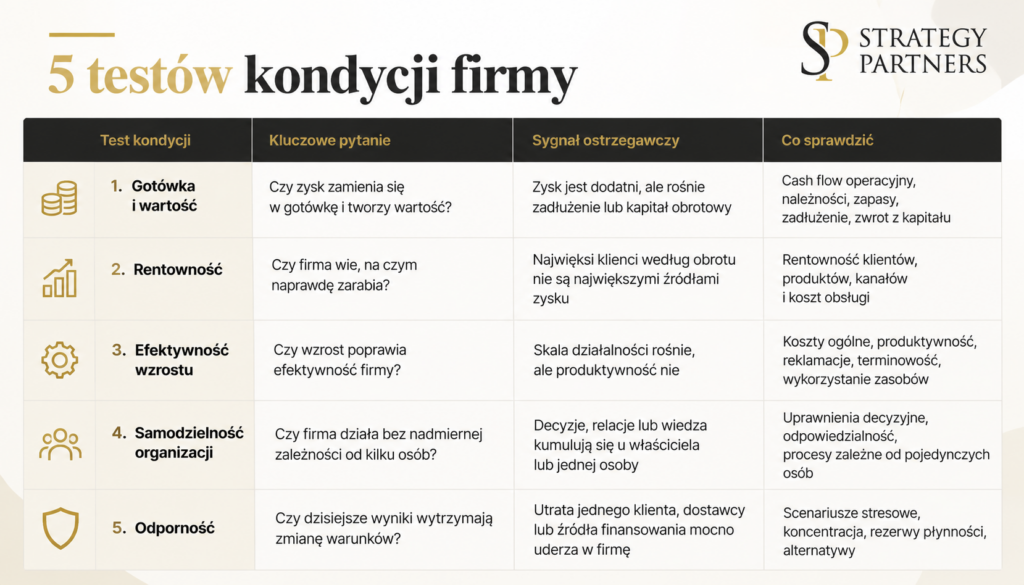
1. Is profit turning into cash and creating value?
One of the first questions when assessing a company’s condition should be:
What actually happened to the profit the company generated over the last few years?
Did it turn into cash, investment, lower debt or a higher company value? Or, on the contrary, despite several profitable years, is the use of the overdraft growing, are liabilities increasing and is the company still feeling liquidity strain?
We see such situations regularly in practice.
A company can report a profit and at the same time need more and more cash. One of the most common reasons is working capital.
If sales grow by 20% but receivables by 35% and inventory by 30%, the company has to finance the difference. The money visible in the income statement stays with customers or in the warehouse.
The faster the company grows, the greater the scale of this phenomenon can be.
Neil Churchill and John Mullins show that a profitable company can run out of cash precisely because it is growing faster than its ability to finance growth allows. In their model, factors such as the length of the operating cycle, the amount of cash needed to finance each additional unit of sales and the cash generated by sales all matter.
That is why profit alone is not enough.
It is worth comparing it with cash flows from core operations over several years and checking how receivables, inventory and payables change relative to sales.
There is a second level to this question. A company may generate cash but tie up a great deal of capital to achieve a relatively small result.
In finance, measures used for this purpose include ROIC, the return on invested capital, and WACC, the weighted average cost of capital. In the long run, a company creates economic value when the return on capital exceeds its cost.
This does not mean that a single year with a lower ROIC automatically indicates poor condition. Investment, the stage of development or the specifics of the industry can temporarily change this relationship.
The most important question, however, is simpler:
Does the capital working in the company earn a return that justifies its use and the risk taken?
Check: how much cash the company’s core business generated over the last three years, and compare this amount with the cumulative result. Then check what happened to receivables, inventory and debt over the same period.
2. Does the company know what it really makes money on?
Owners and boards usually know very well who their largest customers are.
A much more interesting question is:
Is the largest customer also one of the most profitable?
This is not always the same thing.
A customer may generate several million zlotys of sales while requiring special prices, long payment terms, frequent deliveries of small batches, extra service, individual modifications or a large number of complaints.
At the gross margin level it looks attractive. After taking the full cost to serve into account, the picture may be completely different.
The same applies to products. A product with an apparently good margin may require short runs, frequent changeovers, holding stock or unusual logistics.
That is why the company’s average profitability says much less than the structure of that profitability.
Robert Kaplan illustrated this mechanism with the so-called whale curve. In his example of an insurance company, the 40% most profitable customers generated 130% of annual profit. The middle 55% were roughly at break-even, and losses on the remaining 5% of customers reduced the final result by 30%.
This is an example, not a universal ratio.
But the mechanism is very important.
In diagnostic projects we regularly see that high turnover and high profit are not always found in the same place.
This does not mean every low-profitability customer should be removed from the portfolio. A company may consciously accept a lower margin because the customer uses spare capacity, opens a market, increases scale or has other strategic importance.
The key word, however, is: consciously.
The problem is not a low-profitability customer. The problem is a situation in which the board does not know it is not making money on that customer.
Check: prepare two lists: the 10 largest customers by revenue and the 10 largest by profit generated after taking significant costs to serve into account. If the second list cannot be prepared, that in itself is important management information.
Customer and product profitability deserves a separate analysis; it is one of the areas we will return to in later articles in this series.
3. Does growth improve the company’s efficiency?
Revenue growth is one of the most convincing proofs of success.
That is why it can also hide problems effectively.
The company sells more and more, so it hires more people, increases inventory, expands administration and builds out infrastructure. At first glance, everything is a natural consequence of growth.
Until we ask a different question:
Is the company becoming more efficient as a result?
In a company that is developing well, greater scale should bring at least some benefits: better use of resources, fixed costs spread more widely, more efficient processes, greater purchasing power or better use of infrastructure.
This does not always happen.
Growth also increases complexity. More customers mean more trading terms. More products mean more SKUs and more stock. More people mean more communication and more decisions. More exceptions mean more manual workarounds.
The organisation starts solving problems with extra people. Overtime appears. Spreadsheets spring up alongside the main systems. The same problems keep coming back because the company once again deals with the effect instead of removing the cause.
The company is growing, but each additional million of revenue requires more and more effort.
A company can get bigger without getting stronger.
There is no single productivity measure suitable for every industry. In manufacturing, unit cost, capacity utilisation or labour productivity may matter. In distribution, the cost of handling an order and warehouse productivity. In services, utilisation, project margin or value added per employee.
The right question is therefore:
As it grows, is the company using the opportunities to improve efficiency that are specific to its business model?
Check: compare sales growth over the last three years with the change in headcount, overheads and one or two of the most important productivity measures for your business. If scale has grown significantly but productivity has not, it is worth understanding why.
Growth that increases a company’s scale but not its efficiency also deserves a separate article.
4. Can the company operate without excessive dependence on the owner and key people?
You will not find this area in the income statement.
A company may have excellent profitability, stable customers and a full order book, and at the same time its functioning may depend very heavily on one person.
In private companies this is often the owner.
This is natural. The founder built the company and knows the customers, the product, the suppliers and the people. For years he or she made decisions quickly and personally solved the most difficult problems.
This way of working can be a huge advantage at earlier stages of development. But as the company grows, a paradox appears: what used to speed the organisation up starts to slow it down.
More and more decisions go to the owner. Managers know that in the end the boss will decide anyway, so they gradually limit their own responsibility. The owner has more and more work, and the organisation waits longer and longer.
The problem does not concern owners only.
It may be a salesperson who alone has the relationship with the most important customer. A process engineer who alone knows a key process. An operations director without whom nobody can schedule production.
That is why a very good test of independence is a simple question:
What will happen to the company if this person disappears tomorrow for three months?
Research by Bloom, Sadun and Van Reenen covered almost 4,000 companies in the US, Europe and Asia and analysed the delegation of decisions on investment, hiring, production and sales, among others.
The results show that the organisation of decision rights and the ability to delegate matter for how companies scale; however, the research does not support a simple rule of “the more decentralisation, the better”.
A good organisation makes decisions as close as possible to where the competencies, information and responsibility are, without giving up proper control.
Check: list five decisions that required the personal involvement of the owner or CEO in the last month. For each, answer: did it really have to be made at that level?
We will return to the problem of the owner as a bottleneck in more detail in a separate article.
5. Are today’s results resilient to changing conditions?
A company may pass the first four tests very well and still have a significant weakness.
It may be perfectly adapted to the world that exists today.
One large customer accounts for a significant part of sales. One supplier provides a critical component. One channel accounts for most of the growth. One technology provides the advantage.
Concentration in itself need not be a problem. A large customer can provide stability, economies of scale and lower sales costs.
The problem is a dependence whose consequences the company does not know or which it cannot replace.
That is why, instead of adopting an arbitrary threshold for a customer’s share of sales, it is worth carrying out a simple scenario test.
What will happen if the largest customer cuts orders by 30%? What if a key supplier stops delivering for three months? What if the margin falls by two percentage points? What if financing becomes less available?
Resilience does not mean preparing for every possible disaster.
It means room to manoeuvre.
A good point of reference is research by Ranjay Gulati, Nitin Nohria and Franz Wohlgezogen. The authors analysed 4,700 companies during three recessions. Among companies that survived a recession, about 80% needed more than three years to regain their previous sales and profit growth rates, and only about 9% did better after the slowdown than before it while also outperforming industry competitors by at least 10% in sales and profit growth.
The best chance of such a result came from combining improved cost efficiency with continued investment in growth capabilities.
This is an important lesson outside recessions too.
A resilient company does not need the largest reserves or the lowest debt. But it should be able to respond without immediately going into survival mode.
Check: choose three realistic events that could hit your company hardest. Calculate their impact on the result and liquidity, and answer: how long could we operate before the situation forced radical decisions?
Why does the financial result warn too late?
There is one more reason why the financial result alone is not enough to assess a company’s condition.
Financial results largely describe the outcomes of actions taken earlier.
That is exactly why Robert Kaplan and David Norton proposed supplementing financial measures with information about customers, processes and the organisation’s ability to learn and improve.
In practice the mechanism is simple.
The company makes a decision. The decision changes how processes work and how people behave. The effects first appear in on-time delivery, productivity, quality, sales or working capital. Only later do they fully reach EBITDA, profit and cash flow.
That is why falling profitability may be the last rather than the first sign of a problem.
If the company starts signing poorly priced contracts, the problem arises at the moment of signing. If a process loses efficiency, overtime, delays and complaints appear first. If the organisation becomes excessively dependent on the owner, decision times lengthen first.
The result may continue to look good for some time.
How quickly should the board see that something is changing?
Good management information does not mean dozens of reports.
In many companies, much greater value comes from a short, regular report, often weekly, showing the few pieces of information needed to make decisions.
Depending on the business model, these may include:
- the cash position and a short liquidity forecast,
- sales and margin,
- new orders and the order book,
- overdue receivables,
- inventory levels,
- a few of the most important operational indicators, such as on-time delivery, productivity or complaints.
The point is not a specific set that applies to every company.
The point is the principle:
The board should learn about a change in the situation while it can still respond, not a few weeks later from an accounting report.
A single version of the data is just as important. If sales, finance and operations present different values for the same indicator, the company wastes time establishing which number is correct instead of making decisions.
The best time to examine a company’s condition is when its results are good
It may sound paradoxical.
If the company is making money, growing and has no visible problems, why should it analyse its condition precisely then?
Because that is exactly when it has three things it may lack later: time, money and freedom of choice.
It can change the terms of cooperation with an unprofitable customer without fighting for survival. It can put processes in order before their inefficiency starts to affect customers. It can develop managers before the owner becomes a bottleneck. It can reduce a significant dependence before it becomes a real threat.
When problems start to show in the result and in liquidity, the situation looks different.
The bank starts asking questions. Suppliers watch payment terms more closely. Customers notice a decline in quality. The best employees start thinking about their future. The board makes decisions faster and with fewer options available.
That is why a diagnosis does not have to be a response to a crisis.
It can be part of the normal, responsible management of a prosperous company.
Importantly, such a diagnosis does not have to lead to a recovery programme. It may confirm that the company has good foundations. It may reveal opportunities to improve results. It may also point to weaknesses that are small today but will matter more and more as the company grows.
The best time to examine a company’s condition is when its results are good.
10 questions worth asking when the company is doing well
This is not a test in which eight “yes” answers mean a healthy company and five mean restructuring is needed.
These are ten questions worth asking from time to time at a board meeting.
- How much cash did the company’s core business generate over the last three years, and how does this compare with the profit achieved over the same period?
- Is the return on the capital invested in the company adequate to its cost and the risk taken?
- Can we identify the customers, products and channels that generate the most profit after taking the real cost of serving them into account?
- Do we know what part of our sales has low or negative profitability, and why we consciously keep it?
- Is the productivity of our most important resources improving as the company grows?
- Which costs or operational problems are growing faster than the scale of the business, and why?
- Which decisions still require the involvement of the owner or the board, although they could be made lower in the organisation?
- What would happen to the company if the owner or one of the key people were absent for three months?
- How would the company’s result and liquidity change if the largest customer significantly cut its orders?
- Which three changes in the environment could hit our business model hardest today, and how much time would we have to respond?
If the board can answer these questions with concrete data, that in itself says a lot about the quality of management information.
If the answers differ depending on which board member you ask, or preparing the data takes several weeks of work, this does not automatically mean the company is in poor condition.
It is, however, a good reason to look at that area more closely.
A healthy company is not a company without problems
Every company has problems.
Wrong decisions, inefficient processes, difficult customers, recruitment mistakes and failed investments are a natural part of doing business.
The difference between a healthy company and one that is gradually losing condition is therefore not the number of problems.
It lies above all in the ability to notice, understand and solve them.
A healthy company knows where it makes money. It can turn its result into cash. It understands whether growth really improves its efficiency. It does not make business continuity depend on one person. And it keeps the ability to act when conditions stop going according to plan.
It does not have to be the best in each of these areas.
But it should know its own strengths, limitations and most important risks.
That is why it is worth asking, from time to time, a broader question than:
“Do we have a good result?”
The question is:
“Why do we have a good result, and will the mechanism that creates it today still work in two or three years?”
That is a fundamental difference.
The point is not to look for problems that do not exist. It is to check whether good results come from a healthy organisation, and whether they are repeatable.
At Strategy Partners, this is exactly where we start our assessment of a company’s condition. Not with the question “what needs fixing?”, but with understanding where the company really creates value, where it loses it, and which elements of its current way of working may limit its results in the future.
Only such a diagnosis provides a basis for deciding whether changes are needed and, if so, where to start.
Read also
“A company does not fall into crisis overnight: 10 warning signs the board notices too late”, the first article in our series on company condition and recovery.
In future publications we will look more closely at customer and product profitability, growth without economies of scale, and the role of the owner as a potential bottleneck in the organisation.
Want to check your company against these five tests? Book a free call and we will show you where to start diagnosing your company’s condition.
Sources and materials
Churchill, N.C., Mullins, J.W. (2001), How Fast Can Your Company Afford to Grow?, Harvard Business Review, May 2001.
How Fast Can Your Company Afford to Grow? – Harvard Business Review
Kaplan, R.S. (2005), A Balanced Scorecard Approach to Measure Customer Profitability, Harvard Business School Working Knowledge / Balanced Scorecard Report.
A Balanced Scorecard Approach to Measure Customer Profitability – Harvard Business School
Cooper, R., Kaplan, R.S. (1991), Profit Priorities from Activity-Based Costing, Harvard Business Review, May–June 1991.
Profit Priorities from Activity-Based Costing – Harvard Business Review
Bloom, N., Sadun, R., Van Reenen, J. (2012), The Organization of Firms Across Countries, The Quarterly Journal of Economics, 127(4), 1663–1705, DOI 10.1093/qje/qje029.
The Organization of Firms Across Countries – NBER
Kaplan, R.S., Norton, D.P. (1992), The Balanced Scorecard—Measures That Drive Performance, Harvard Business Review, January–February 1992.
The Balanced Scorecard—Measures That Drive Performance – Harvard Business Review
Gulati, R., Nohria, N., Wohlgezogen, F. (2010), Roaring Out of Recession, Harvard Business Review, March 2010.
Roaring Out of Recession – Harvard Business Review
Koller, T., Goedhart, M., Wessels, D. (2025), Valuation: Measuring and Managing the Value of Companies, 8th edition, Wiley / McKinsey & Company.
Valuation – Wiley