Lead leakage rarely starts at the pricing stage. It usually starts earlier, at the moment a company receives a contact from a customer with high purchase intent but cannot quickly take ownership of the next step. HBR and McKinsey research shows that speed of response and smooth handling are now part of competitive advantage, not just an add-on to the offer.
For the board the conclusion is simple: ineffective handling of quote requests is not a “soft” customer service problem. It is a problem of revenue, CAC and marketing efficiency, because the organisation pays for leads it does not monetise. HubSpot indicates that cutting lead response time to 5–30 minutes can clearly improve conversion, and McKinsey shows that a well-organised customer experience model translates into, among other things, higher sales conversion and a lower cost to serve.
The most expensive lead is the one the company has already won
The most expensive lead is not the one the company never won. It is the lead already generated, often paid for with the marketing budget, already exposed to the brand and ready to talk, that disappears somewhere between the contact form, a CRM queue and a missing next step. HBR described this phenomenon more than a decade ago, and McKinsey data shows that the problem has not gone away; in an omnichannel world it affects customers’ purchasing decisions even more.
In practice this means an organisation can “do marketing” and lose sales at the same time. If a customer comes to the company with a clear intention to buy and the process does not quickly give them an answer, an owner and a confirmed next step, the company does not have a demand problem. It has a problem monetising demand.
Case study: how companies lose a ready quote request
The starting point is a simple but representative case. A request to buy office equipment, a MacBook and two Dell monitors worth about PLN 18,000 gross, was sent to two large IT resellers. One supplier replied the next day but did no follow-up. The other came back asking whether the request was still current and then sent no quote for five days. The author was more inclined to buy from the second supplier, but the lack of response weakened his readiness to buy and stalled the process.
This case is not an accusation against specific companies. It is an operational signal. The customer had a specific need, a known basket and high purchase intent. This means the problem did not lie in generating demand but in the transition from interest to quoting and managing the sales opportunity. It is exactly this moment that HBR identifies as critical: companies that contacted a lead within an hour were nearly seven times more likely to qualify it than those that waited longer than an hour, and more than 60 times more likely than those that waited 24 hours or more.
Four gaps through which B2B companies lose leads
The key insight is simple: in high-ticket sales, speed of response and process continuity have become part of the offer itself. McKinsey indicates that a lack of speed in interactions with suppliers remains the number one pain point for B2B customers and is mentioned about twice as often as price. At the same time, buyers today expect a genuinely seamless omnichannel model, not just a company presence in many channels.
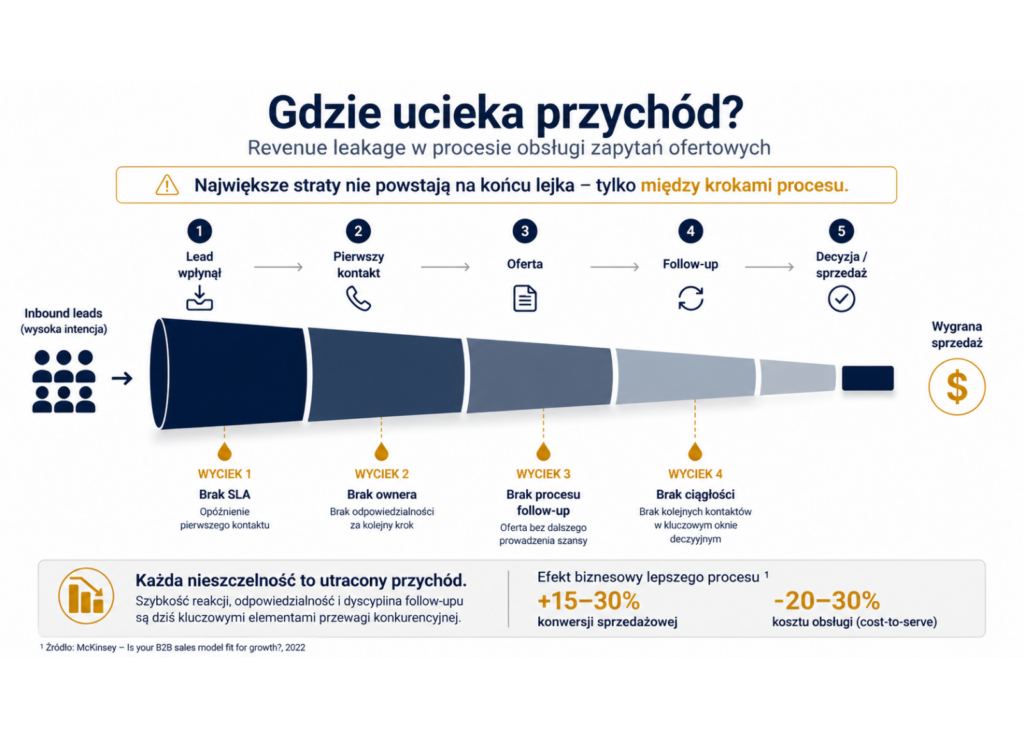
The first gap is no lead ownership. Salesforce describes lead management as an orderly sequence of stages: capture, qualification, distribution, nurturing and tracking. If, after an enquiry arrives, there is no single person responsible for taking it over, preparing the quote and scheduling the next step, the lead is not really being managed. It is merely recorded. The difference seems subtle but is operationally fundamental.
The second gap is no follow-up process. A one-off reply is not a sales process; it is an event. Outreach, analysing 12 million prospects, showed that about 60% of interested buyers respond within one day and more than 92% within 14 days. Salesforce also stresses the role of cadences, designed sequences of contacts that set out when a salesperson should write, call or wait for the next step. Without this discipline, the opportunity cools faster than the organisation manages to get back to it.
The third gap is no response SLA. HubSpot defines an SLA between marketing and sales as a two-way commitment: marketing is responsible for delivering leads and sales for contacting them within an agreed time. Without an SLA, the organisation does not track time to first contact, time to quote or the number of follow-ups completed. As a result, performance depends on the goodwill of individuals rather than on a managed operating standard.
The fourth gap is misalignment between marketing and sales. McKinsey states plainly that the days when marketing “throws the lead over the wall” to sales are over. From the customer’s point of view, the company should act as one organism. Meanwhile, Salesforce shows that 79% of customers expect consistent interactions across departments, yet 55% feel they are dealing with separate silos rather than one company. At this point lead leakage stops being a sales problem and becomes an operating model problem.
How much does lead leakage cost? The scale of the problem
The model below is illustrative and conservative. It assumes only the loss of revenue on the first basket and does not include margin, upselling, repeat purchases or the opportunity cost of ineffective marketing. The formula is simple: lost revenue = number of leads × average basket × leakage rate. The model assumes an average basket of PLN 18,000 and three leakage levels: 5%, 10% and 20%.
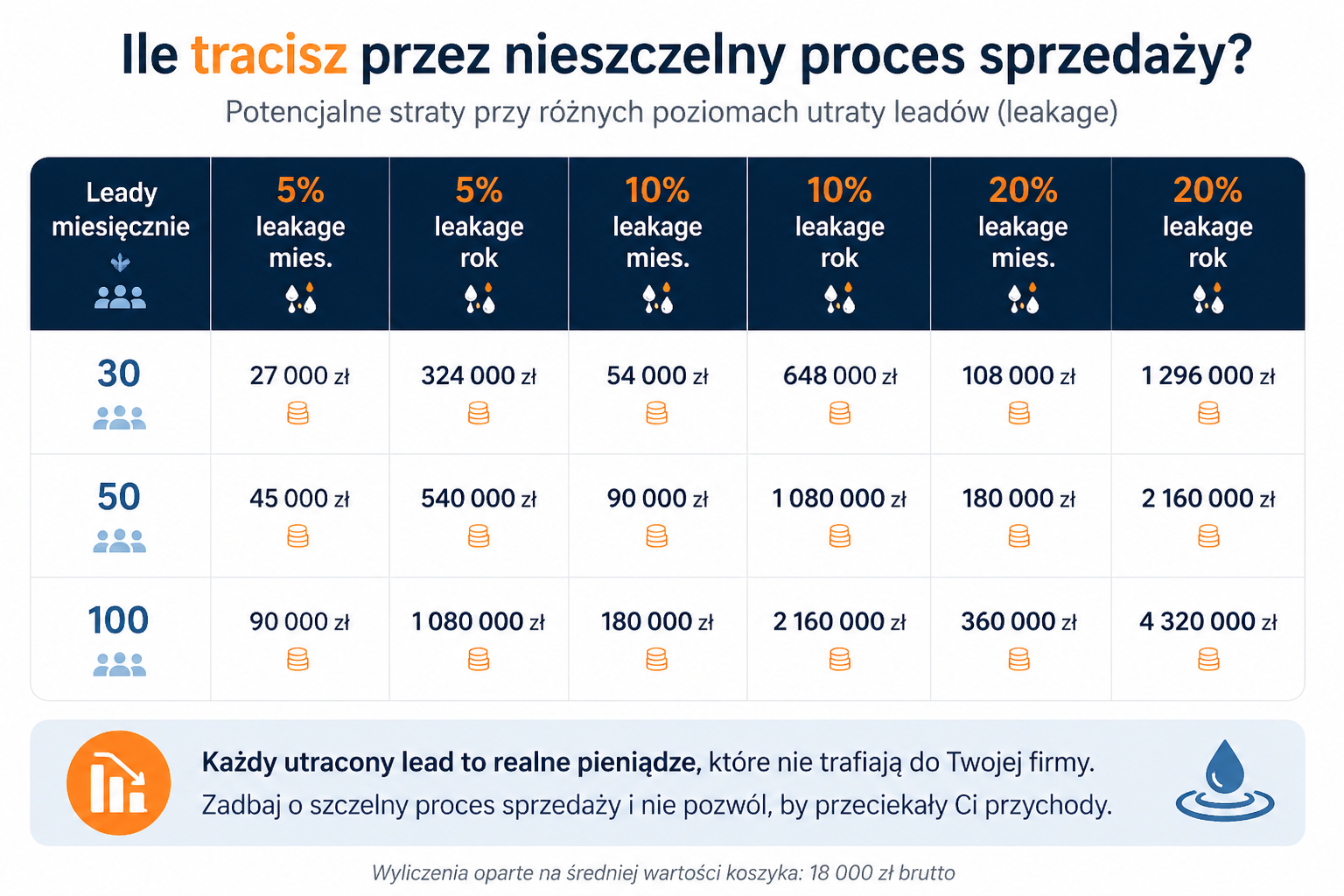
Even at a relatively low leakage rate of 5%, the amounts are significant. With 50 inbound enquiries a month, this means PLN 540,000 of lost revenue a year on the first basket alone. At 10% it exceeds PLN 1 million a year. That is why the problem should not be classified as a minor process defect but as a regular leak from the revenue funnel.
McKinsey also shows that pressure on the quality of experience is growing: the average B2B buyer uses ten different ways of interacting across the buying journey, and more than half of respondents say they are ready to switch suppliers if the experience across channels is not seamless. This means the cost of leakage is not limited to a single form. Every moment of friction in the process increases the likelihood of the customer moving to a competitor.
What lead leakage means for revenue, CAC and marketing
The first implication is a direct impact on revenue. If a company organises its customer experience and the operating model around it effectively, it can increase customer satisfaction, improve sales conversion and lower the cost to serve. McKinsey indicates that a well-designed CX operating model can bring about a 15% increase in sales conversion and about a 30% lower cost to serve. From a financial perspective, improving lead handling therefore works on both the growth side and the cost side.
The second implication is higher CAC. Simple unit logic is enough: if the cost of generating leads stays the same but fewer enquiries reach the opportunity and win stages, the cost of acquiring a customer rises automatically. HubSpot stresses that reporting CPL, CAC, conversion and pipeline impact together in one system reduces blind spots between marketing and sales. In other words, where there is no closed-loop reporting, the organisation often sees the cost of acquiring a lead but not the cost of losing it.
The third implication is lower marketing efficiency. Marketing may deliver leads according to plan, but if sales responds too slowly or does not follow up, part of the marketing spend never turns into pipeline. HubSpot points out that lead response time should be monitored as a separate metric, and Salesforce reminds us that tracking lead activities in the CRM is essential for better forecasting and management decisions. Without this visibility, a company may wrongly conclude that it needs more leads when in reality it needs to handle the ones it already has better.
Finally, there is the loss of relationship value. McKinsey shows that effective experience-led growth strategies can increase cross-selling by 15–25% and share of wallet by 5–10%. This means lead leakage takes away not only the first transaction but also the customer’s future value. In this sense, failing to respond to a good quote request is a loss of future cash flow, not just of current sales.
How to stop lead leakage: four recommendations
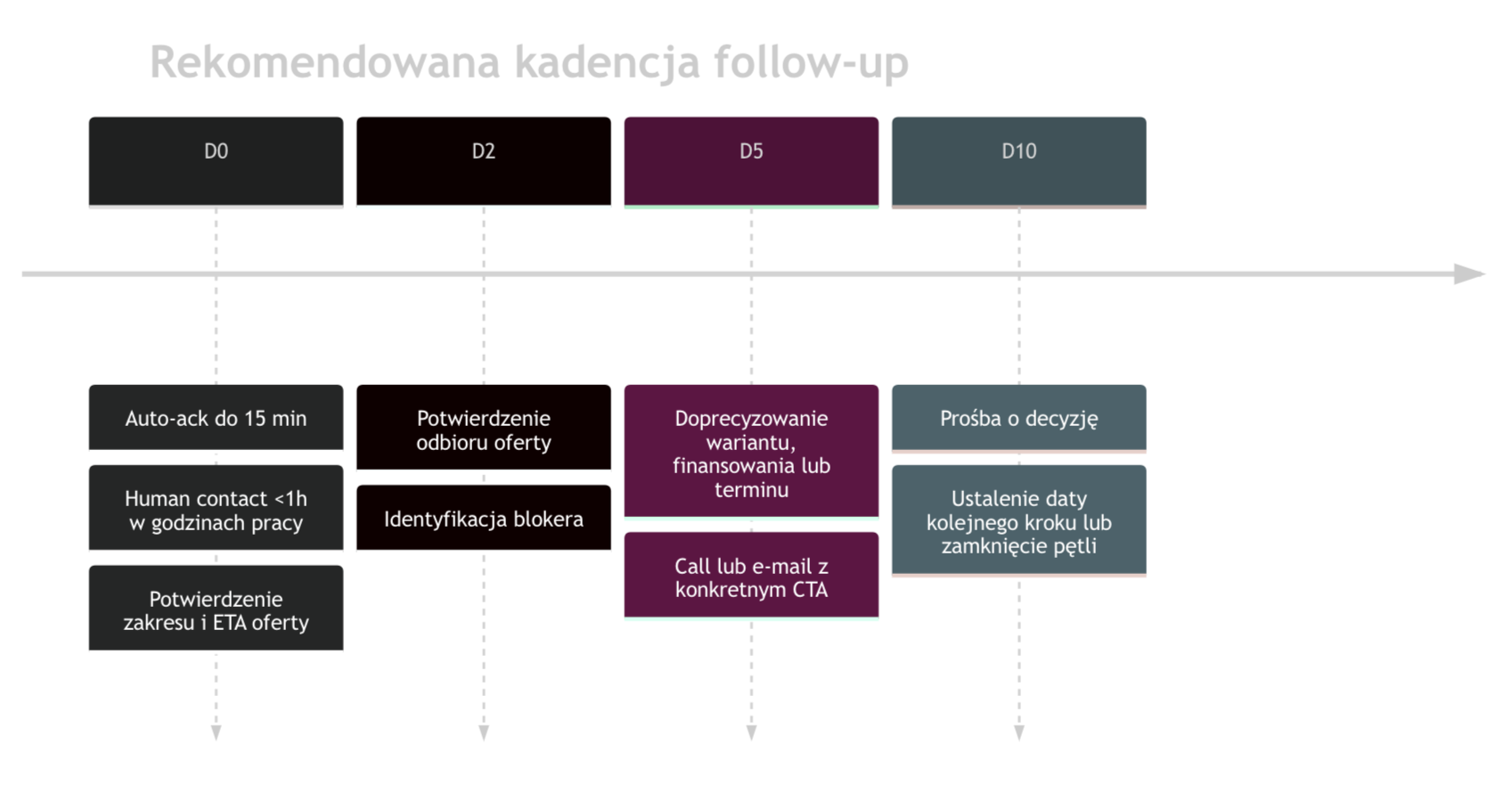
The first recommendation is a minimum speed standard. For high-intent inbound leads, it is worth introducing an automatic acknowledgement within 15 minutes and human contact within an hour during working hours. If the enquiry arrives outside working hours, first contact should happen no later than the next working day, and the quote should be sent within 24 hours in standard cases. This recommendation combines HBR data on the sharp drop in effectiveness over time with HubSpot’s guidance that getting below 30 minutes can improve conversion.
The second recommendation is a mandatory follow-up cadence. For high-ticket transactions, the recommended sequence is: D0 acknowledgement and agreement on the next step; D2 confirmation that the quote has been received and identification of any blocker; D5 clarification of the option or terms; D10 a request for a decision or for a specific date to come back. This is not aggressive pressure. It is control of the process rhythm in the time window in which responses and decisions are statistically most likely.
The third recommendation is an assigned owner and a closed-loop CRM. Every lead should have an owner from the moment it arrives. The CRM should record the lead source, first response time, time to quote, the date of the next step, the win/loss result and the reason for loss. Salesforce stresses distribution and tracking as fully fledged stages of lead management, and HubSpot enables reporting on lead response time, pipeline health and CPL and CAC, among other things. It is at this level that “handling” ends and revenue management begins.
The fourth recommendation is a shared set of KPIs for marketing and sales. The minimum package should include first response time, time to quote, follow-up completion rate, lead-to-opportunity, opportunity-to-win and source-level CAC. The SLA between marketing and sales should specify not only lead volume but also sales’ commitment to make contact within a set time and maintain the agreed follow-up discipline. HubSpot and Salesforce agree: an effective system requires both clear stage definitions and unambiguous accountability.
Summary
The case described is not a story about two salespeople. It is a diagnosis of an operating model in which a company can generate interest but cannot take ownership of monetising it. For the CEO, the most important conclusion is therefore not “we need more leads” but “we must reduce leakage more aggressively in the leads we already win”. HBR shows how quickly leads go cold, and McKinsey that in an omnichannel world customers treat speed and a smooth process as part of the value of the offer.
Most often a company does not lose a ready lead on price; it loses it in the silence between the first contact and the next step.
Key conclusion 1: if a lead has entered the funnel but the organisation has no owner, SLA or follow-up cadence, the problem is not demand; the problem is revenue leakage.
Key conclusion 2: the cheapest growth is usually better monetisation of existing inbound, before the company spends another zloty on generating new traffic.
Where is revenue leaking in your company?
Most companies do not need more leads. They need to handle the ones they already have better.
If you want to check:
- what your real lead response time is
- where ownership is missing
- how many enquiries never reach a quote
- how big the real “revenue leak” is
Book a short call and we will show you, using your own data or process.
Data sources and inspiration:
- Harvard Business Review (2011), The Short Life of Online Sales Leads
- McKinsey & Company, The B2B Customer Experience: A Key to Growth
- McKinsey & Company, The New B2B Growth Equation
- McKinsey & Company, B2B Pulse Survey
- HubSpot, Lead Response Time Statistics
- HubSpot, Service Level Agreement (SLA) Guide
- HubSpot, Closed-Loop Reporting
- Salesforce, State of the Connected Customer
- Salesforce, Lead Management Guide
- Outreach, Sales Execution Report