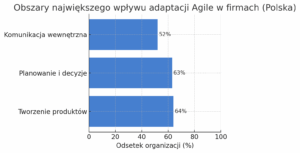
Do multi-year strategies still make sense in a world where everything changes at the pace of a sprint? Traditional strategic planning, with rigid multi-year roadmaps, is increasingly at odds with reality. Today few companies dare to create a five-year plan when it is hard to predict even the next two. In a turbulent business environment, agile strategic management, which combines a long-term vision with flexibility of action, is gaining importance. This is not just a fashion borrowed from IT: eight out of ten Polish companies already use agile working methods, and 63% of them use them in planning and decision-making. With competitors accelerating, boards must ask themselves: how do we bring elements of Agile into our own strategy so as not to fall behind?
The key challenge: strategy in an age of unpredictability
Strategic planning has traditionally been based on the assumption of relative stability: analysing trends, forecasting the market and setting a course for years ahead. But in the digital era and a VUCA world (volatility, uncertainty, complexity, ambiguity), it has become clear that rigid plans quickly become outdated. New technologies, changing customer preferences, the arrival of disruptive start-ups and crises (such as the pandemic) can all overturn the most carefully prepared strategy. Company boards therefore face a dilemma: how to maintain a long-term direction of development while keeping the ability to change course quickly when the situation requires it?
Strategic management today must keep up with the operational pace. Research shows that organisations moving to an agile operating model achieve better results. According to McKinsey, teams working with Agile methods are 1.5 times more likely to report above-market financial results, and 81% of companies that have completed an agile transformation see a clear improvement in efficiency. Agile teams can test innovations and respond to feedback faster, which reduces the risk of misguided investments and allows market opportunities to be seized before competitors do. The problem is that many companies implement Agile only in pockets, for example in IT teams, while the rigid strategic planning and budgeting process at the level of the whole organisation remains the bottleneck. If the board still plans initiatives and resource allocation in an annual cycle and project approval takes months, even the most agile teams will get stuck. In short: you cannot be a fully agile company without an agile strategy.
The key strategic challenge is therefore reconciling opposites: providing a stable, coherent vision of development (the so-called North Star, which sets the direction) while allowing continuous course correction and quick decisions along the way. This requires a change in managers’ mindset: moving away from treating strategy as a document towards seeing it as a process. Strategy can no longer be a ceremonial plan updated once a year; it becomes a living mechanism that is subject to iteration, inspection and adaptation, just like a product in Scrum. As Brunon Bartkiewicz, CEO of ING Bank Śląski, put it: “For an organisation to be agile, it has to keep changing its agile ways of working… Nothing is set in stone.” In other words, in a world of constant change, even the way we plan must itself be improved and its assumptions questioned.
New frames of thinking: Agile in strategic planning
So what does agile strategic management look like in practice? The literature uses the concept of strategic agility, defined as a company’s ability to continuously adapt and reconfigure its resources and activities in response to changes in the environment while maintaining a long-term competitive advantage. Researchers Yves Doz and Mikko Kosonen identified three pillars of such agility: strategic sensitivity (alertness to market signals and quick recognition of opportunities and threats), leadership unity (the ability of top management to change direction together and decisively) and resource fluidity (the ability to move people and capital quickly to where the greatest value appears). These concepts translate into very practical solutions used today by companies implementing Agile at the level of the whole organisation.
First, the horizon and rhythm of planning change. Instead of a detailed strategy five years ahead, companies are moving to iterative planning in shorter cycles. The long-term vision is still set (for example where the company wants to be in a few years), but the path to that goal is regularly reviewed. Quarterly planning is becoming increasingly popular: every quarter or more often, boards review strategic initiatives, progress and priorities. Such a “strategic sprint” allows the course to be corrected in response to new circumstances without abandoning long-term ambitions. For example, a global insurer found that its annual budget cycle was stifling innovation, because teams had to wait many months for funding for promising ideas. The solution was to set aside part of the budget and allocate funds every quarter: agile teams could apply for small amounts of funding in stages to develop a new concept to the next milestone, after which they presented the results and received further funding or the green light to scale the idea. As a result, promising initiatives no longer had to wait until the end of the year, and the company got ahead of competitors in introducing new solutions.
Second, strategies become more measurable and transparent to the whole organisation. An agile approach involves cascading the vision into concrete goals that teams understand. The OKR (Objectives and Key Results) method is helpful here. Objectives set out what we want to achieve, and key results how we will measure progress. Companies using OKRs usually define strategic goals for a year and then monitor their achievement every quarter and correct them where necessary, both the goals themselves and the initiatives designed to achieve them. A bottom-up approach is important: teams and business units can propose their own goals and budget needs, which are then agreed with the board, so employees feel they are co-authors of the strategy and understand its assumptions better. A single goal for many teams can unite efforts remarkably well. An example is a large financial institution that made improving customer service its priority and defined an OKR: cut the cost of customer service by 50%. Achieving it required coordinating the work of several squads, from product through IT to risk. Management brought the leaders of these teams together and agreed a plan of action, and each team was assessed on one shared dimension: the degree of reduction in the cost of service. Such a clearly defined strategic goal made the teams focus on finding savings and set aside initiatives that did not fit the overarching goal. This shows how turning strategy into a concrete OKR helps keep the whole company’s activities coherent.
Third, companies scale Agile beyond IT, creating structures that foster agility. Individual Scrum teams working in an agile way are not enough if the rest of the organisation operates hierarchically. That is why corporations adopt frameworks such as Scrum of Scrums, LeSS or SAFe (Scaled Agile Framework) to implement agility at the level of entire departments and project portfolios. SAFe in particular has become popular in banking, manufacturing and telecommunications as a way of combining “the best of both worlds”: the agility of small teams with appropriate oversight and synchronisation at the scale of a large company. In the SAFe approach, the company’s strategy is translated into strategic themes: the most important business priorities at portfolio level, expressed as measurable goals (most often as OKRs). Strategic themes provide the context for investment decisions and direct the work of Agile Release Trains and teams so that everyone moves in the same direction. This preserves stability in the form of clearly defined, shared goals, which allows teams to make decentralised decisions day to day, confident that they fall within the company’s strategic intent. In addition, SAFe introduces a rhythm of reviews and planning across the whole organisation (such as regular PI Planning, during which hundreds of people agree the plan of action for the next quarter at the same time). As a result, the company operates like a “fleet of agile boats” rather than a heavy tanker: it keeps the mass and resources of a large corporation but is manoeuvrable, because shared directions are updated often and communicated to everyone involved.
Finally, organisational culture becomes the foundation of an agile strategy. Structure and processes alone are not enough if people still think in silos and fear change. Agile strategic management requires building a culture of trust, experimentation and shared responsibility for the company’s results. Leaders must give teams autonomy in implementing the strategy: set out what to achieve but leave freedom as to how. This approach pays off: agile companies record higher employee engagement and faster talent development. The example of the European e-commerce platform Zalando shows that by taking the Agile philosophy to the level of the whole organisation, a company can accelerate business growth, deliver new features to customers faster and free employees from time-consuming procedures so that they can focus on solving problems. An agile culture is one in which learning from failure and continuous improvement are natural, from frontline teams to the board. Strategy then becomes a shared undertaking of the whole company rather than a top-down plan locked in a drawer.
Agility in practice across industries: from manufacturing to e-commerce
What does an agile approach to strategy mean in different sectors? Although the idea comes from the world of technology, its influence can be seen today in manufacturing, finance and e-commerce: wherever the pace of change demands greater business flexibility.
- Industrial manufacturing: in factories, Agile is associated with improvements on the production line (lean manufacturing, Just-In-Time). But agility is also entering long-term production decisions. Manufacturing leaders increasingly plan new investments and product development in short cycles, with rapid prototyping and market testing. For example, the global manufacturer Bosch created internal start-up incubators to develop new ideas quickly outside the main structures: so-called “speedboats” allow innovations to be tested free from the weight of the corporate tanker. In hardware projects (such as electronics and automotive), Scrum teams of engineers iteratively design and improve prototypes of machines and devices. As a result, time to market is shorter and the product strategy can be adjusted after each sprint review with the customer. Even in Poland, manufacturing companies see the need for strategic agility: for example, furniture and household appliance manufacturers respond to changes in demand by quickly redesigning their offer and shifting production capacity to where the greatest return is expected. Agile in manufacturing therefore means being ready to change the direction of investment plans from year to year, or even from quarter to quarter, if the market requires it (for example sudden changes in raw material prices or the emergence of new technologies).
- Banking and financial services: the financial sector, although associated with regulation and caution, has in recent years become a pioneer of large-scale agile transformation. Banks face pressure from fintechs and from digital customers’ expectations, which has forced them to speed up the cycles of launching new services. In Poland, an example is ING Bank Śląski, which several years ago rebuilt its organisational structure on a model of agile tribes and squads modelled on fintechs. Strategic initiatives, such as the development of mobile banking and cloud services, are carried out there by multidisciplinary teams working iteratively, with frequent releases. ING’s management stresses that it did not mechanically copy Agile methods but adapted them to its own culture. The aim was to build a sense of shared ownership of the strategy among employees at every level. As a result, as Bartkiewicz describes, employees feel they are “owners of their part of the organisation”, which increases their responsibility for the results of the whole. In practice, banks implement elements such as regular portfolio reviews (every quarter the board assesses the progress of strategic initiatives and can shift funds from less promising projects to more promising ones) and management by objectives through OKRs, for example setting how many active mobile app users the bank wants to gain in a quarter and monitoring this indicator every week. An agile strategy in banking also means investing in a culture of innovation: banks organise hackathons, intrapreneurship programmes and quick experiments (such as piloting a new feature for 5% of customers to collect data before a wider rollout). All this shortens the feedback loop and allows the board to adjust its strategic assumptions dynamically. It is no surprise that, according to Deloitte research, 80% of Polish companies, including banks, say they use Agile, and one of the most common areas is planning and decision-making, which is the domain of boards.
- E-commerce and the technology sector: e-commerce companies have been built on agility from the start: rapid experimentation, A/B testing and continuous improvement of the customer experience are in their DNA. Their challenge is keeping this start-up flexibility as they grow. The European fashion giant Zalando grew within a few years from a small shop into a platform employing thousands of people, which at first, paradoxically, slowed down the pace of innovation. The remedy turned out to be a thorough change in the management model: introducing agile methods not only in IT teams but also in the way business goals were defined and in the organisational structure. Zalando focused on maximum autonomy for product teams, a clear division of responsibility and a learning culture. The result? The company can develop many new initiatives at once (from its own clothing brand to a marketplace for external sellers), enter new market segments quickly and regularly deliver improvements to its platform. As Zalando’s Eric Bowman has noted, agility drives a flywheel effect: each successful action fuels the next success, allowing the business to scale without losing momentum. The global leader Amazon takes a similar approach, known for its “two-pizza teams” principle (small, autonomous teams that can be fed with two pizzas) and a planning cycle based on frequent experimentation and drawing conclusions very quickly. Amazon’s strategy is deliberately flexible: instead of detailed annual plans, the company sets key directions (such as expansion into new categories or the development of cloud services) and then lets dozens of initiatives compete for resources, scaling those that deliver the best results. In Polish e-commerce, dynamic scaling while staying agile can be seen in the example of Allegro: as the platform grew, the company invested in a microservices architecture and OKRs so that every team could adapt quickly to market changes without losing sight of the overarching goals (such as increasing market share or buyer satisfaction).
In general, Agile principles are being applied in an ever wider range of industries. From electric car manufacturers speeding up model cycles, through banks automating credit processes in iterations of a few weeks, to pharmaceutical companies organising drug research in sprints, agility is becoming the answer to time pressure and uncertainty. Importantly, each sector adapts Agile in its own way, taking its specifics into account. Agile strategic management is therefore not a rigid recipe but rather a set of principles: short learning cycles, customer focus, employee empowerment and readiness to correct the chosen path.
How to implement agile strategic management: practical approaches
The concepts described above translate into specific actions a board can take to make its strategy more agile. Below we summarise the key practices and recommendations for organisations wishing to adopt Agile methods in long-term planning:
- Define a “North Star” and limit the number of priorities: define a clear vision or overarching goal that will guide the whole company. Then choose a few (3–5) key strategic priorities for the coming period (a year), instead of a list of a dozen or more initiatives. Less is more: focusing on fewer goals makes them easier to communicate and achieve. Providing stability in the form of these clearly defined strategic goals will help teams orient themselves better.
- Introduce regular strategic reviews and sprints: plan a regular rhythm (for example quarterly) of meetings of the board and key managers at which the progress of initiatives and changes in the environment are assessed. Treat them as strategic iterations: at each meeting, decide whether to change priorities, fund new ideas or stop projects that are not delivering results. This frequency will let you allocate resources faster to where they have the greatest effect, instead of being stuck in an annual planning cycle.
- Use OKRs to link long-term goals with current results: use the Objectives and Key Results methodology across the organisation. Set annual goals (strategic objectives) and assign them measurable quarterly results (key results) that will be ambitious milestones. Make sure the OKRs are transparent to all employees: everyone should know how their work translates into the company’s strategic OKRs. Every quarter, assess progress on the OKRs: which goals are on track and which need correction or additional action. Remember to involve middle managers and teams in setting OKRs: their bottom-up proposals will ensure the goals fit operational realities better.
- Use scalable Agile frameworks (Scrum/SAFe) for coherence: if your company is large or operates in many business units, consider implementing a framework for scaling Agile. The Scaled Agile Framework (SAFe) offers proven practices for managing a project portfolio in line with strategy, such as defining strategic themes, maintaining a portfolio backlog (a list of large strategic initiatives ordered by priority) and establishing a Lean Portfolio Management process to oversee investments. Regular Big Room Planning (planning workshops with representatives of many teams) will help ensure that everyone is up to date with the strategic direction. Teams keep their autonomy but move within a shared roadmap, and any conflicts of priorities are resolved as they arise rather than months later.
- Make budgeting flexible and fund innovation quickly: review the traditional budgeting process with agility in mind. Instead of freezing the budget allocation for the whole year, set aside a pool for development projects and innovation that you will allocate in short cycles (for example quarterly). Set simplified approval procedures so that promising initiatives can get the green light within weeks rather than at the next annual meeting. The practice of global leaders shows that staged funding (allocating funds step by step once agreed results are achieved) significantly increases the speed and effectiveness of innovation. This ability to move resources fluidly, people and capital, to where opportunities arise is one of the pillars of strategic agility.
- Build a culture based on learning, trust and empowerment: the best methodology will not work if people do not have the courage to use it. As a leader, promote accountability rather than control: make clear what is expected (the goals), but leave freedom as to how they are achieved. Encourage small-scale experiments and sharing of lessons (including from failures). Introduce Agile rituals at board level, such as strategic retrospectives (discussing what worked in recent decisions and what could be done better next time) or management stand-ups (short weekly meetings for heads of department to exchange information). The example comes from the top: if the board shows that it is ready to change its assumptions and admit mistakes, the whole organisation will find it easier to move into continuous improvement mode. As Bartkiewicz said of ING’s transformation: “A solution we worked out the day before yesterday, we are obliged to question today.” Such an attitude at the top of the company sets the pattern for all teams.
- Measure, analyse and respond to data in real time: use modern digital tools to monitor key indicators of strategy execution (KPIs linked to OKRs, market data, customer feedback). Set up alert mechanisms: for example, if sales in a segment fall for two consecutive quarters or a new competitor appears with an innovative product, the signal should reach the board table immediately, triggering a review of strategic assumptions. An agile strategy is based on feedback loops: the faster the organisation learns to interpret signals from its environment and its own processes, the more efficiently it will correct its plans. Data becomes the fuel of the agile approach: strategic decisions should be based on current insights, not on out-of-date slides from a year ago.
Is your strategy agile enough?
A changing business environment requires a new approach to strategy from companies. Agile strategic management is no longer a theoretical concept but a practice used by market leaders in Poland, Europe and around the world. The best companies can run in sprints without losing sight of the marathon: combining fast iterations, frequent decisions and closeness to the customer with a consistent pursuit of a long-term vision. Introducing elements of Agile into strategic planning does not mean an overnight revolution or abandoning all existing methods. It is an evolutionary process in which, step by step, we shorten decision cycles, open up to change and engage the whole organisation in achieving shared goals.
For boards and business owners this means new challenges but also huge opportunities. An agile strategy can become a source of competitive advantage: it allows you to respond to market changes faster than rivals, make better use of emerging opportunities and avoid costly mistakes by testing assumptions early. Companies that master this art earn a reputation as innovators and employers of choice (because they attract people who value autonomy and dynamic development).
But can every organisation be agile? The key question at the end is: is your strategy ready for continuous course corrections? If your current strategic plan has been gathering dust on the shelf since the last board retreat, perhaps it is time to breathe new life and rhythm into it. Agile strategic management is the way to make strategy a truly living part of the company: one that develops with its environment instead of lagging behind. In a world where the only constant is change, it is the ability to adapt that will determine success. Will your company take up this challenge and join the organisations that are resilient to market shocks? The decision is yours, and the future of your business is at stake.
All the examples and data cited confirm one thing: Agile in strategy works, but it has to be skilfully adapted to the realities of your organisation and industry. By using common sense and drawing on the experience of experts (including Strategy Partners), every company can gradually increase its ability to make strategic turns without losing sight of its ultimate goal. It is worth starting this transformation today because, as a well-known agile saying goes, “the best time to adapt was yesterday, and the second best time is now”.
Want your strategy to become truly agile? Contact the experts at Strategy Partners and together we will turn your vision into a flexible, iterative process that will drive your company’s long-term growth.
Data sources and inspiration: the Deloitte Agile Maturity 2023 study (digitalandmore.pl); statements by Brunon Bartkiewicz (CEO of ING Bank Śląski) for MIT Sloan Management Review Polska (mitsmr.pl); McKinsey & Company analyses of agile organisations (mckinsey.com); Scaled Agile Framework (SAFe) practices (scaledagileframework.com); a McKinsey interview with Eric Bowman of Zalando (mckinsey.com); literature on the concept of strategic agility (Doz & Kosonen, 2008) (wydawnictwo.ue.poznan.pl).